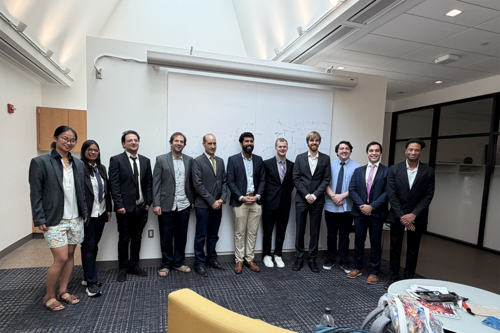
On July 16, Asheesh Momi successfully defended the thesis, “The Physics of Cochlear Dynamics and Tuning” (Advisor: Ben Machta).
Momi explained, “The cochlea, a spiral-shaped organ in the inner ear, separates sound into different frequencies and amplifies extremely faint vibrations. In my thesis, I used mathematical and computational models to study the natural ways in which the cochlea can vibrate. It supports two very different types of motion: localized vibrations, which connect a sound frequency to a particular position, and collective vibrations, which are a smaller number of modes that extend across much of the cochlea. These collective modes have largely been overlooked, but they may place important limits on how the active cells of the inner ear amplify sound without making the system unstable. They may also help explain why healthy ears can sometimes produce faint sounds of their own.”
In September, Momi will begin a postdoctoral fellowship continuing in theoretical biophysics at the University of Toronto, he will be helping Professor David Hathcock start his lab as his first postdoc. Hathcock is starting as a professor this summer.
Thesis Abstract
The human ear is a remarkably active mechanical system, capable of detecting faint sounds, sharply resolving frequency, and operating over an enormous dynamic range. These abilities arise from sound-induced surface waves on the cochlea’s basilar membrane, whose response is classically understood in terms of localized modes that peak sharply at frequency-dependent positions. However, my work shows that the cochlea also supports a distinct set of collective low-frequency extended modes, whose motion resembles global standing waves. This new mode structure raises several questions: how can active forces tune localized modes to high sensitivity without destabilizing extended modes, why do two qualitatively different classes of modes arise, and what role might extended modes play in hearing? Through computational and analytic modeling, this work investigates how active feedback, cochlear geometry, and mode structure together shape the sensitivity and stability of hearing.
Thesis Committee: Benjamin Machta (advisor), Thierry Emonet, Christopher Lynn, Joe Howard, Pascal Martin (Institut Curie)