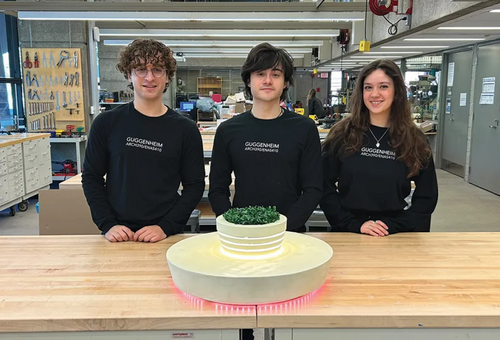
From its wheelchairs to its famous spiral ramp, the Guggenheim teams up with Yale Engineering to rethink the museum experience.
George Ploumis (YC’2026 Mechanical Engineering and Physics (Intensive) double major and a member of Sigma Pi Sigma, the Physics and Astronomy Honor society ) participated in the Guggenheim project as part of the course “Making Spaces (ARCH 390/ENAS 410),” in the Sound Team along with Henry Kaplan (YC’2025 Physics (Intensive) and Mechanical Engineering double major, a member of Sigma Pi Sigma, and a winner of the Howard L. Schultz, Sr. Prize, awarded by the Yale Physics Department) and Alina Susani (YC’2026 Architecture).
The Solomon R. Guggenheim Museum, designed by Frank Lloyd Wright, is now considered an iconic work of 20th-century architecture. Completed in 1959, the art museum’s building is known both for its dramatic spiral exterior as well as the “single continuous floor,” as Wright described the building’s interior ramp.
But in the intervening 65 years, a lot has changed in New York City, in the world, and in museums. So has the way the Guggenheim activates its architecture through exhibitions and programming, cultivates its relationship to the city, and defines its role as a public and civic space.
“We at the museum have been thinking a lot about that intersection of architecture and visitor experience,” said Chitra Ramalingam, director of academic engagement at the Guggenheim. “Not just how to realize the museum’s potential as an inclusive educational civic space, but as a space of connection and belonging.”
As a former faculty member at Yale, Ramalingam was familiar with the Center for Engineering Innovation & Design (CEID). When she moved to the Guggenheim in 2023 to develop new kinds of academic partnerships, CEID Executive Director Joe Zinter, Ph.D., was one of the first potential collaborators she reached out to. Together with Ashlyn Oakes, M.Arch, the CEID’s program manager, they began discussing a full collaboration, in which students would spend the semester exploring these big questions at the core of the Guggenheim’s spatial and cultural identity. Many of the challenges Ramalingam and her colleagues were wrestling with are just the sort of things considered in “Making Spaces (ARCH 390/ENAS 410),” a course that Zinter and Oakes teach. This interdisciplinary course, blending principles of engineering and architecture, invites students to explore how design and technology can enhance museum experiences for a broad public.
 Over a period of several weeks, Ramalingam, Zinter, and Oakes worked out a plan for the Spring 2025 course, defining five challenges to spark the students’ innovative spirits. The end result, Ramalingam said, was “an incredible success.”
“The students were so engaged, so thoughtful and creative,” she said. “They asked such smart and probing questions. They really got right to the heart of these five different challenges, often in ways that I and my colleagues at the museum hadn’t necessarily considered. So I was really, really impressed by that.”
An interdisciplinary course cross-listed between Engineering and Architecture, Making Spaces collaborates with clients who work with the students to reimagine a space, often in ways that go beyond simply identifying a technical solution or architectural intervention. It’s a complex challenge that requires the students to work across disciplines to develop creative solutions and designs, while considering feasibility, viability, desirability, and other constraints.
In other words, it’s the perfect course for considering museum space. Shortly before it closed for renovations in 2020, Making Spaces teamed up with the Peabody Museum. Students worked closely with museum representatives to develop ways for Peabody visitors to experience the renovated galleries. A student project from that collaboration became the basis for a start-up company, Amuse Technologies, which is now the navigation platform being used in the Peabody Museum. In other years, the course has worked with the Smithsonian Arts and Industries Building, for which students developed interactive tours and other innovations.
Working with the Guggenheim proved to be just as fruitful a collaboration.
“As one of the world’s most influential and iconic museums, collaborating with the Guggenheim was a very exciting opportunity and the course garnered tremendous interest from students,” Zinter said. “The challenges presented by Chitra and her team were multifaceted and nuanced, and they required our students to develop deeply creative and holistic solutions that engaged with the cultural, spatial, and human dimensions of the museum experience.”
The students were divided into five teams, each tasked with finding a new way to approach a different aspect of the museum. The class included guest lectures and a tour of the Guggenheim itself.
“It was inspiring to work with such a talented and interdisciplinary group of students, whose diverse perspectives led to these creative and innovative solutions,” Oakes said.
From the Yale Engineering news story about the Sound Team, “Museums are multi-sensory spaces, and the curved, concrete surfaces of the Guggenheim make it a complex — and sometimes challenging — auditory environment. Rather than seeing its unusual acoustics as a problem, the team embraced them. How could they create a memorable experience for Guggenheim visitors out of the unique sonic character of the space? Their first step was to think of the building as a sonic instrument itself.
This led the three students to design the Whispering Bench, an interactive sound installation for the sidewalk outside the museum designed to catch people’s attention and then activate as they pass by. Approaching the circular bench, designed to evoke the building’s circular form, triggers an audio recording that offers passersby a sensory preview of the reverberating sound within the museum. The team intends the piece to spark curiosity, draw visitors into the museum, and encourage a deeper awareness of how form and material influence sound.”
Ploumis commented, “The unique geometry of the Guggenheim museum creates a very challenging acoustic environment. Given the structure’s landmark status, there was very little my team and I could do to ‘fix’ it, so we chose to celebrate it. Its shape is reminiscent of the particle collider detectors that have been the focus of my physics research. We saw the museum as a musical instrument whose geometry echoed that of a particle detector and used simulation tools to explore the sound inside it. Instead of simulating how particles interact with matter, we simulated sound. Working with Alina Susani (Architecture) and Henry Kaplan (Mechanical Engineering and Physics), we translated this physical tool into an experience that lets guests feel how the rotunda’s sound is itself a record of Frank Lloyd Wright’s architectural signature.”
Kaplan, currently working as a mechanical design engineer at Mini-Circuits in New York, added, “My experience working on the Whispering Bench was the perfect project to end on before graduating. The combination of engineering, physics, architecture and artistic skills that went into it encaptures the wide-ranging and interdisciplinary education that Yale excels at teaching. Making Spaces showed us that we do not have to follow only one path, and that the combination of many different skill sets, both creative and technical, often lead to more successful outcomes. This project and course influenced me to continue to pursue artistic endeavors alongside my career goals in engineering and physics.”
Susani concluded, “As an aspiring architect who has always been inspired by museums, it was an incredible opportunity to work with the Guggenheim Museum throughout the project’s process. The Guggenheim is a very important architectural landmark, and examining its features through the lens of acoustics allowed me to consider its architecture—and structures as a whole—from a new perspective. By creating something at the scale of the body, as we did with our Whispering Bench, we wanted to highlight the multi-sensory experience of the museum while also allowing visitors to understand the museum’s unexpected elements.”
This story was adapted from the Yale Engineering story of April 29, 2026. Photos by Solomon R. Guggenheim Foundation / Filip Wolak. Please see below for a link to the original article and other related links.