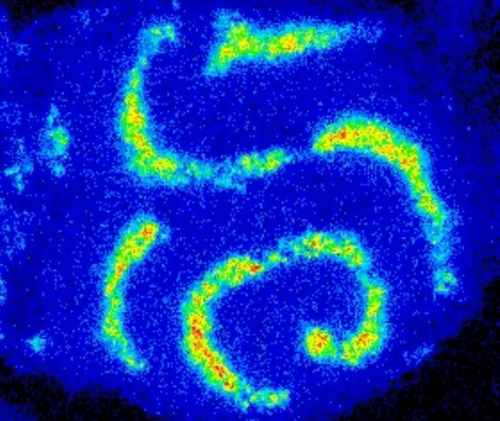
On November 20, XJ Xu successfully defended the thesis “Non-Equilibrium Pattern Formation in a Living Cell” (advisor: Min Wu).
Xu explained, “I am fascinated by patterns that emerge spontaneously in nature, such as sand ripples shaped by wind in the desert. It amazes me how simple building blocks like grains of sand can organize into beautiful inch-wide ripples or even dunes that span miles. During my PhD, I turned to a world a million times smaller and very much alive to explore a similar idea. Inside a single living cell, simple molecular building blocks—lipids and proteins—can also organize into traveling “ripples” that sweep across the cell surface like a crowd wave in a stadium. The way that living cells organize matter into patterns goes beyond known physical principles and demands new ones. And I’d like to find out what those might be.”
Xu continued, “I plan to be a Postdoctoral Fellow at the Arnold-Sommerfeld Center for Theoretical Physics, Ludwig-Maximilians-Universität München.”
Thesis abstract