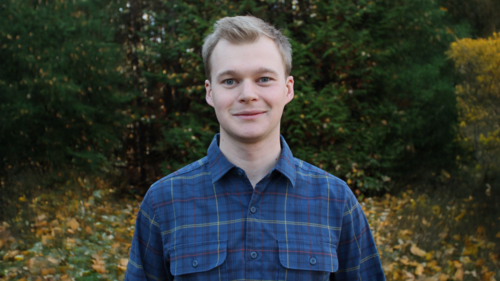
Matthew Leighton, Mossman Fellow, has received a fellowship from the National Science and Engineering Research Council of Canada (NSERC) as part of the Canada Postdoctoral Research Program. The Canada Postdoctoral Research Award (CPRA) program recognizes and supports the next generation of outstanding innovators, knowledge workers, creative thinkers and researchers at a pivotal time in their careers. The program provides funding and flexibility, empowering Canadian and international leaders in innovation and scholarship of tomorrow to develop the skills to build world-class research and drive Canadian prosperity and competitiveness.
Regarding winning the fellowship, Leighton commented, “It’s an honor to be awarded an NSERC postdoctoral fellowship from the government of Canada to help support my research at Yale. I’ve been fortunate to receive fellowship support from NSERC at several stages of my career (undergraduate, masters, doctoral, and now postdoctoral), for which I am very thankful. This financial support from the Canadian government has made it possible for me to pursue a career in Science. “
Leighton was born and grew up in Vancouver, Canada. He moved to Halifax, Canada to study physics and mathematics at Dalhousie University, where he learned the ropes of biophysics research from professor Andrew Rutenberg, graduating with a B.Sc. Honours in 2020. Matthew then moved back to Vancouver to pursue a Ph.D. in Biophysics at Simon Fraser University under professor David Sivak. He successfully defended his PhD in Fall 2024, and subsequently moved to New Haven, USA to start as a Mossman Postdoctoral Fellow with the Department of Physics and Quantitative Biology Institute at Yale University. He is currently working with Chris Lynn, assistant professor of physics, and Ben Machta, associate professor of physics.
Leighton’s published research to date explores topics such as the thermodynamics of energy conversion by nanoscale molecular machines, how collective behaviour of motor proteins facilitates intracellular transport, and the structure and mechanics of collagen fibrils. Since starting at Yale, he’s begun working in a number of new areas, including the nonequilibrium thermodynamics of Cryo-electron microscopy, information usage in bacterial chemotaxis, thermodynamics and geometry of mitochondria, and optimal encoding of positional information in the hippocampus. When he’s not working on scientific research, Matthew can generally be found enjoying the outdoors: running, biking, surfing, sailing, or skiing.
Lynn, commented, “Matt is an incredible young scientist, and this fellowship is a deserving recognition of that fact. With this fellowship, Matt will have even more freedom to pursue his research interests at the intersection of physics and biology. We’re excited to explore how non-Markov dependencies (which are absent in the laws of physics) emerge in biology. Matt has also been investigating whether, and how, the brain constructs optimal encodings of physical position in neural activity. The flexibility to pursue such high-risk and diverse projects is only possible with fellowships like the one from the Canadian NSERC.”