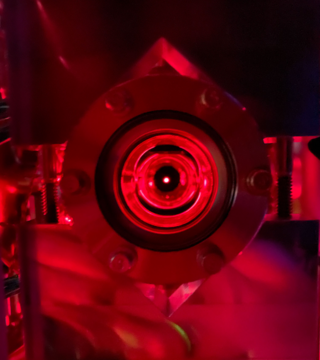
a liquid helium refrigerator

Atomic, Molecular, and Optical Physics

Atomic, Molecular, and Optical Physics

Researchers in AMO physics at Yale are studying the fundamental interactions of light and matter from the scale of single atoms and molecules to massive (nano-gram to milli-gram scale) optomechanical systems.  These experiments are pushing new frontiers in controlling and characterizing the properties of these systems, with applications to studying quantum many-body systems, manipulating and cooling single molecules, studying the mechanical properties of massive objects in the quantum regime, and precision sensing for tests of fundamental physics.

For further information, see Atomic, Molecular & Optical Physics @ Yale web site

Recent AMO News

Upcoming Events

Nothing to share right now.

Please check back soon or explore our site.

Experiments

Search for new Interactions in a Microsphere Precision Levitation Experiment (SIMPLE)

Levitated Optomechanics (SIMPLE)

The Moore Group is developing new technologies aimed at answering some of the major outstanding questions in nuclear and particle physics.  Answering these questions requires applying cutting-edge techniques from particle, nuclear, atomic, and optical physics in experiments aimed at understanding the basic building blocks of the universe. 

Lithium 7 MOT

Quantum Gases in Optical Lattices

The Brown Research Group builds experiments that utilize the exquisite control and precision of atomic physics to study phenomena in condensed matter physics and particle physics.

A large piece of machinery in a lab

Ultracold Quantum Matter

The Navon research group at Yale University specializes in the study of the quantum many-body problem using highly-controllable ultracold quantum matter. We aim at improving our understanding of quantum phases of strongly-correlated matter, and explore the emergence of universal states in far-from-equilibrium quantum dynamics.

scientific measuring equipment

Rydberg Atoms as Yale (RAY)

Professors Maruyama and Brown are developing Rydberg atoms as photon sensors for axion searches.  Rydberg atoms are atoms with a very high principal quantum number, meaning an excited valence electron likely exists far from its nucleus. The high energy level and large radius of Rydberg atoms gives them interesting and useful properties, and the Rydberg Atoms at Yale (RAY) phase of HAYSTAC will exploit these atoms’ sensitivities to detect single axion-converted microwave photons.

Group Members

Support Staff